




AI companies have stooped to a new low in their attempt to part students from their money. We have seen the development of agentic browsers (like Comet) and tools like OpenClaw that will “work” on your behalf. The problem is that this cuts out your chance of learning. Adopting these tools in assessments would be viewed by educational institutions as deliberate attempts at deception and trying to circumvent the assessment, possibly with severe consequences.
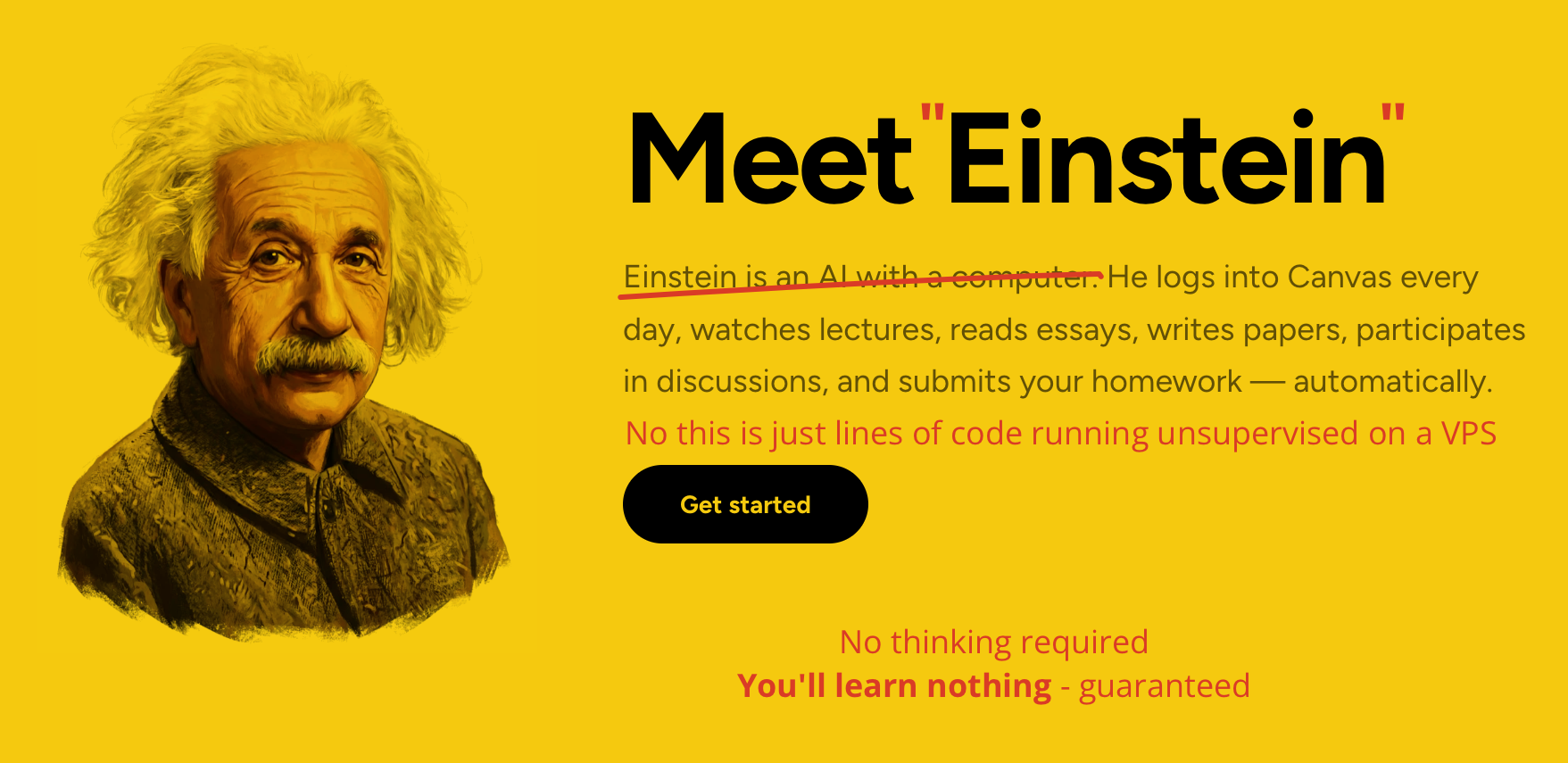
A recent example are the adverts that have started appearing for a tool exploiting the reputation of the German physicist Albert Einstein (1879 – 1955). If you part with your money, your passwords and access credentials, then it will perform some bizarre rite of digital resurrection and “Einstein” will impersonate you online.
Prices start at $40 a month, but surely you’ll want the “popular” Pro plan at $100 per month, or if you are struggling, perhaps it’s worth a stretch to the Max plan at $200. Hey that’s only $2,400 a year, or $7,200 over a typical three year degree. Oh and you’ll probably need to pay for extra AI credits on top of that too.
The tool claims that with your University login credentials, it will log into the popular VLE Canvas and create activity that looks like it was you. It will play videos, post comments in discussion boards, take online tests and complete assignments. The only thing it won’t do is help you learn. There’s no struggling with the content, no attempt to challenge and refine your mental model, no ambiguity to navigate, just pay the money and move on.
I’m sure the name isn’t an accident (or approved by his relatives). It’s harnessing anthropomorphism to try and suck people in, give this tool a veneer of respectability and hide the fact that this is blatant cheating. This is code dressed up as your online “friend” with whom you can “chat” with using apps like Telegram or Discord.

These two FAQ entries should be enough to set off alarm bells that there is something very wrong with this service:

Handing your login credentials to a third party is likely to be a breach of every university or college’s IT regulations.
Asking “Will my professor know?” and not even answering the question is a bad sign. The answer will be “Yes” when they talk to you and realise that the work submitted does not match the way you think and talk about the subject.

The saddest thing is that someone believed this strapline.
There are no shortcuts to understanding or learning. You need to put the effort (not the dollars) in. Education is about changing the way you think and see the world, helping you develop your own perspectives and appreciate those of others. That takes time and effort. It requires listening to others, talking to others, reading the work of others, experimentation. Trying, failing, trying, over and over again. Sounds tough, but we can all do it and have been doing it for thousands of years.
Online tools like this are just cheating. Spend your money on something more useful. Spend your time learning.
Screenshots and prices correct as of 24th February 2026.